
Should I stay, or should I go?
Open LinkedIn on any given day and you'll see it: another round of layoffs, a steady stream of "open to work" posts, and people wondering out loud if their field even has a future. The 2020s have been brutal for knowledge workers across tech, academia, healthcare, government, and media, and the mass layoffs are only part of it. The budget cuts, political interference, and AI shenanigans have made it clear that nothing is guaranteed anymore.
Work has always carried some amount of uncertainty and risk; what's different now is the scale and frequency of it. No field or area of expertise is truly safe from technological change or the forces of capitalism that would see every job automated or eliminated if financially beneficial.
Cheerful stuff! Anyway, sorry to be the bearer, but I know you aren’t here for the sugarcoated version.
The questions I hear most from clients, peers, friends, and in the general online discourse have changed accordingly. Career conversations used to be about optimistic opportunity: how to get your foot in the door, get ahead, and change paths if you got bored. Now they're about grappling with the fallout: "How do I hold on when things are changing so rapidly?"; "Is it even worth looking for a job in this market?"; "Do I even want to be here anymore?"; and, if not, "What's next for me, and how the hell do I get there?
Eyeing the exit
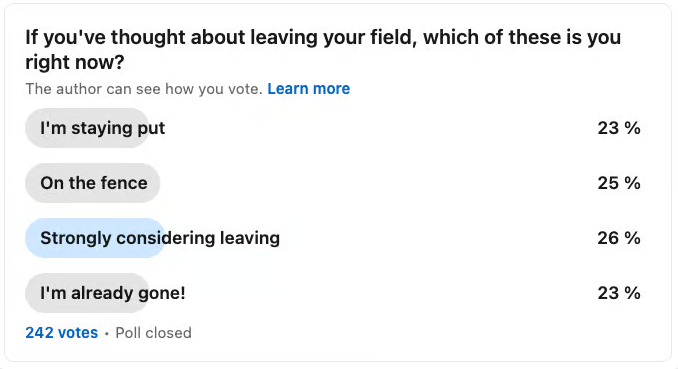
I recently ran an unscientific LinkedIn poll asking people who had thought about leaving their field where they were at in their thinking—if they’re staying put, on the fence, strongly considering it, or already gone. 242 people answered, and 75% of respondents were either actively considering leaving, or have already bailed.
The results don’t surprise me. People are restless, fed up, and eyeing the door. They no longer believe in the work. They’re burned out from what is (let's be honest) organizational exploitation, and blaming themselves for not coping better. Some have spent twenty years building a professional identity, only to realize they're ready for something entirely new.
To stay or to go
It sounds like a clean binary, but we all know firsthand that it’s a lot messier. Most of us are working within real limits, without complete autonomy to shape our situation. We’ve got mortgages, families, debt, a job market wasteland, a socioeconomic system that is generally unfair to most humans, and if you’re in the US, you need the damn health insurance.
Leaving takes a lot of forms: you can join a new company, change fields, go back to school, become self-employed, or step back to figure it out with no particular plan. Maybe you left of your own accord, maybe you were laid off.
Not everyone is leaving, of course. Maybe what you have works well enough, you’re ok with tolerating the BS for a while, you’re “acting your wage” as they say, or leaving is just too risky. If you keep the same job, you might also change your relationship with it (in case it wasn’t clear, this account condones checking out, quiet quitting, caring selectively, reclaiming your time, etc.).
We all have our reasons, and there is no correct answer. The point is that a lot of people are in motion and reckoning with an ever-evolving new normal.
Four rooms
Think of the four poll options above as a collection of rooms, broadly described. If you’ve thought about or are currently thinking about leaving, you might recognize yourself in one of them, or more than one depending on the day. Odds are you've stood in every one of them at some point in your working life. I certainly have.
You probably already know which room you're in (or leaning toward) these days, so the relevant question becomes “what do I do from here?” Here's what each one tends to feel like from the inside, and a few questions to help you get an honest read on your situation. Maybe they'll even nudge you toward a decision, or give you an extra dose of validation for one you've already made.
🚪 Room 1: Staying put
You've decided to stay for the foreseeable future. Maybe you’ve evaluated the options and know that what you’d give up by leaving outweighs what you’d gain. Or maybe leaving isn't on the table right now. It doesn’t mean you’re fine, but it’s a defensible call, not a failure.
if you're in this room:
Are you actually staying, or have you already left in every way except the two weeks’ notice?
What would need to be true for staying to feel like your decision rather than your only option?
How can you make the most of your job—shaping it to your advantage—while you’re still there?
🚪 Room 2: On the fence
If it feels like you’re wavering or being “too picky”, it’s likely because it's a genuinely complicated situation with a lot to consider: your goals, relationships, priorities, finances, and the real risks involved in any life-altering choice.
if you're in this room:
What information are you missing in order to make a decision?
What feelings come up on the days you lean toward leaving and the days you think about staying?
Are you actually undecided, or are you avoiding the decision?
🚪 Room 3: Strongly considering leaving
This is no longer a question of whether to go, but when and how. Your gut, your emotions, and your research have made it clear that leaving is the right move for you. That is, unless something major changes that makes work more tolerable or fulfilling. You're working through the practical questions: your runway, the logistics, what you'll do next, the story you'll tell others (and importantly, the story you’re telling yourself). You've given yourself permission, and now you're doing what you can to reduce the risk, knowing you can't eliminate it entirely.
if you're in this room:
Based on what you know today, would you take the leap tomorrow?
Are you running toward something, or away from something?
How long have you been “considering leaving”, and is it a holding pattern or are you making progress toward the exit?
🚪 Room 4: Already gone
You've left the building. Depending on the day, and whether it was your choice or someone else’s, this room holds a lot of emotions: relief, excitement, grief, guilt, satisfaction and vindication. Maybe you have a plan, or maybe you’re staring at a big fat question mark.
if you're in this room:
Who are you, now that you’re no longer the thing you used to be?
What are you feeling or thinking that you didn’t see coming?
Physically you’ve left, but have you actually moved on?
Wherever you find yourself
I don't think the room you're in is the most important thing. You can be content in one room and miserable in the next one over, and the "right" room changes over time. What matters more is acknowledging that you’re in the room, assessing your situation, and making a decision that is truly yours.
